India has emerged as one of the world’s important ceramic and porcelain tile manufacturing and export hubs. Tile manufacturers, particularly those operating from Gujarat’s Morbi cluster, supply products to customers across Europe, the UK, the Middle East, Africa and other international markets.
Competitive pricing, expanding product ranges, improving quality and growing manufacturing capabilities have helped Indian tile companies strengthen their position in the global market.
However, the US–Iran conflict and disruptions around the Strait of Hormuz have introduced new challenges for the Indian ceramic industry.
For Indian tile manufacturers and exporters, the impact is being felt primarily through two critical areas:
1. Rising energy costs
2. Increasing freight and logistics costs
These pressures are changing manufacturing economics and could influence how Indian tiles compete in international markets.
1. Rising Energy Costs Are Putting Pressure on Tile Manufacturers
Tile manufacturing is an energy-intensive industrial process.
Ceramic and porcelain tiles are produced using materials such as clay, feldspar and other minerals. After preparation and forming, the products pass through high-temperature kilns where they are fired to achieve their required strength, finish and technical characteristics.
Because of this, fuel and energy costs are a major part of tile manufacturing expenses.
Disruptions connected with the Strait of Hormuz have increased pressure on energy markets and fuel supply. The impact has been particularly important for Morbi, Gujarat, one of India’s largest ceramic manufacturing clusters.
Many factories in the region depend on gas and other energy sources to operate production lines. When fuel prices increase significantly, manufacturers face higher production costs and, in some cases, may have to reduce operating hours or temporarily suspend production.
Gas Cost Pressure on Manufacturers
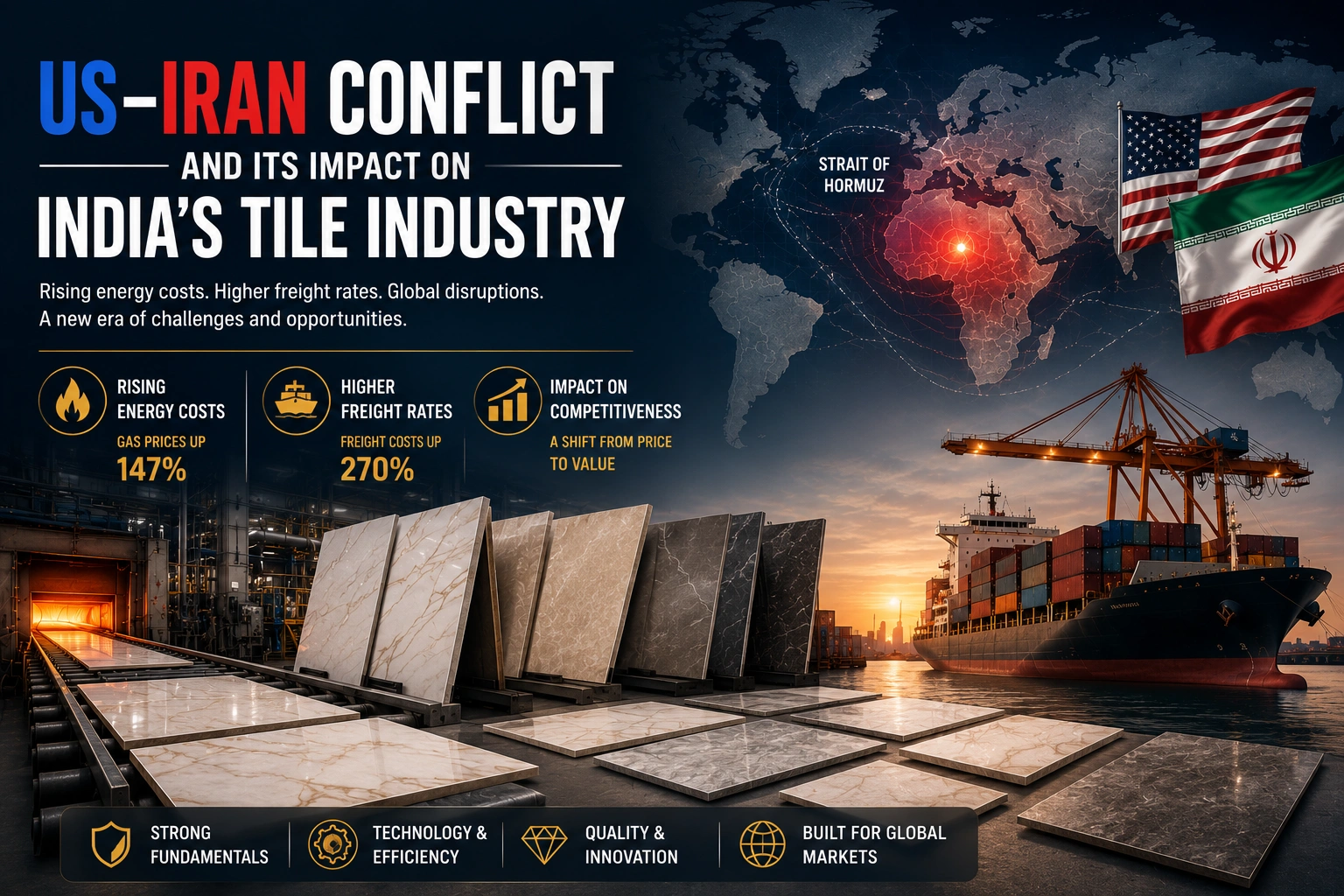
Based on our current market observations, the cost of gas used by manufacturers has increased from approximately:
₹36/kg before the crisis → around ₹89/kg as of 18 August 2026
That represents a substantial increase in a key manufacturing input.
For tile producers operating on high production volumes and relatively competitive selling prices, such an increase can have a significant effect on margins.
Manufacturers therefore face three choices:
- Absorb the additional cost and accept lower margins
- Increase tile prices
- Improve production efficiency to reduce the impact
Important: Any specific production-suspension figure, such as reports of more than 400 Morbi factories stopping production, should be independently verified and cited before publication.
2. Freight Costs Are Creating Another Major Challenge
Energy is not the only issue affecting the Indian tile export industry.
International shipping has also become more expensive and less predictable.
Indian tile exporters, particularly manufacturers based in Gujarat, rely heavily on maritime transportation to reach customers in Europe, the UK, the Middle East and other regions.
Mundra Port is an important export gateway for manufacturers in western India.
Before the recent disruption, container freight from India to European or UK destinations could be around US$1,400 per container, depending on the route, carrier, equipment availability and market conditions.
Some routes are now seeing costs of approximately:
US$1,400 → US$5,200 per container
That difference can have a major effect on the final landed cost of ceramic and porcelain tiles.
Because tiles are heavy and relatively high-volume products, transportation costs can represent a meaningful component of the overall price paid by international buyers.
3. Shipping Disruptions Are Affecting Delivery Planning
The challenge is not limited to the freight rate.
International exporters are also dealing with changes in:
- Vessel schedules
- Shipping routes
- Container availability
- Transit times
- Port operations
- Freight quotations
- Delivery commitments
When shipping capacity is redirected because of disruptions in the Gulf region, exporters on other routes may experience reduced vessel availability and higher freight costs.
For international tile buyers, this creates another concern:
Delivery timelines become harder to predict.
For Indian manufacturers and exporters, logistics planning is therefore becoming just as important as production planning.
4. Will Indian Tile Prices Increase?
The combined effect of higher energy expenses, freight rates, raw-material costs and other operating expenses is putting pressure on the overall cost structure of Indian tile manufacturers.
India has historically benefited from a strong combination of:
Competitive manufacturing + large production capacity + affordable raw materials + skilled workforce
This has helped Indian tile exporters compete successfully in international markets.
However, when energy and logistics costs rise sharply, maintaining the same price advantage becomes more difficult.
The Competitive Landscape
Indian manufacturers compete with major tile-producing countries including:
- China
- Spain
- Turkey
- Italy
If India’s manufacturing and shipping costs continue to rise, buyers may become more sensitive to the total landed cost rather than simply the factory price.
This could gradually change the way Indian tile companies compete globally.
5. The Global Tile Market May Shift From Price to Value
For years, price competitiveness has been one of India’s strongest advantages in international tile markets.
But the current environment could encourage a broader shift.
Instead of competing only on:
“Who can offer the lowest price?”
manufacturers may increasingly compete on:
“Who can provide the best overall value?”
That value can include:
- Product quality
- Surface design
- Technical performance
- Consistency
- Size availability
- Packaging
- Delivery reliability
- Customer service
- Product innovation
- Competitive pricing
This could be particularly important in premium and design-oriented markets such as the UK and Europe.
6. Technology Could Become More Important for Indian Tile Manufacturing
The current pressure may also accelerate a transformation that was already taking place in India’s ceramic industry.
Indian manufacturers are increasingly investing in:
- Modern production lines
- Digital printing technology
- Advanced glazing systems
- Improved porcelain bodies
- Surface development
- Automation
- Production efficiency
- Quality-control systems
The objective is no longer simply to manufacture tiles at the lowest possible cost.
The bigger opportunity is to manufacture products that provide higher perceived and technical value.
Indian manufacturers are increasingly studying premium tile markets such as Spain and Italy and adopting advanced technologies and design approaches to develop products capable of competing at a higher level.
7. India Still Has Strong Fundamentals
Despite the current challenges, the long-term fundamentals of the Indian ceramic tile industry remain strong.
India benefits from:
Strong Raw-Material Availability
The country has access to important minerals and raw materials required for ceramic production.
Established Manufacturing Clusters
Morbi has developed into one of the world’s most significant ceramic manufacturing centres.
Large Skilled Workforce
The industry has built substantial manufacturing expertise over decades.
Growing Technology Adoption
Indian factories continue to invest in modern machinery, digital printing, glazing and automation.
Established Export Networks
Indian tile manufacturers have developed relationships with buyers, distributors and importers across multiple international markets.
These advantages provide a strong foundation even during periods of higher production and logistics costs.
8. India’s Competitive Advantage Could Evolve
The traditional perception of Indian tile exports has often centred around competitive pricing.
But the industry may increasingly move towards a broader proposition:
From “Lowest Price” to “Best Overall Value”
This could be one of the most important changes for India’s tile export industry.
A manufacturer that offers slightly higher pricing but provides:
Better design + consistent quality + reliable supply + technical performance + dependable service
may ultimately create more value for an international buyer than a supplier offering only the lowest quotation.
9. What We Are Seeing at Top Notch Tiles
At Top Notch Tiles Exporters Pvt. Ltd., we are closely following these developments because our business is strongly connected with international markets, particularly the UK and Europe.
Our conversations with customers indicate that price remains an important purchasing factor, but buyers are increasingly looking beyond price alone.
International customers are paying greater attention to:
- Attractive surface designs
- Realistic textures
- Consistent glazing
- Strong porcelain bodies
- Product quality
- Batch-to-batch consistency
- Reliable supply
- Delivery timelines
This creates an important opportunity for Indian manufacturers.
The next phase of India’s tile industry may not simply be about producing tiles at lower prices.
It may be about producing better products at competitive prices.
10. What Does the Future Hold for Indian Tile Exports?
The US–Iran conflict and related disruption in energy and shipping markets have created genuine uncertainty for India’s ceramic and tile sector.
Manufacturers and exporters are now paying greater attention to:
Energy → Production → Freight → Logistics → Landed Cost → Customer Pricing
A change at any one point in this chain can affect the final price and competitiveness of Indian tiles.
However, disruption can also encourage innovation.
The current environment could accelerate investments in:
- Energy efficiency
- Manufacturing automation
- Product innovation
- Premium tile development
- Supply-chain planning
- Export diversification
- Technology-driven production
The Road Ahead for India’s Tile Industry
ndia does not need to compete only as a low-cost tile manufacturing country.
With its manufacturing scale, raw-material availability, skilled workforce, technology adoption and established export network, India has the potential to compete more directly with major global tile-producing markets such as Spain, Italy, Turkey and China.
The future competitive proposition could increasingly become:
Quality + Design + Reliability + Technology + Competitive Cost
rather than price alone.
At Top Notch Tiles, we believe the current challenges could ultimately encourage India’s ceramic industry to become more technology-driven, quality-focused and internationally competitive.
The next chapter of India’s tile industry may not be about being the cheapest manufacturer in the world.
It may be about becoming one of the best-value and most capable tile manufacturing centres in the world.