
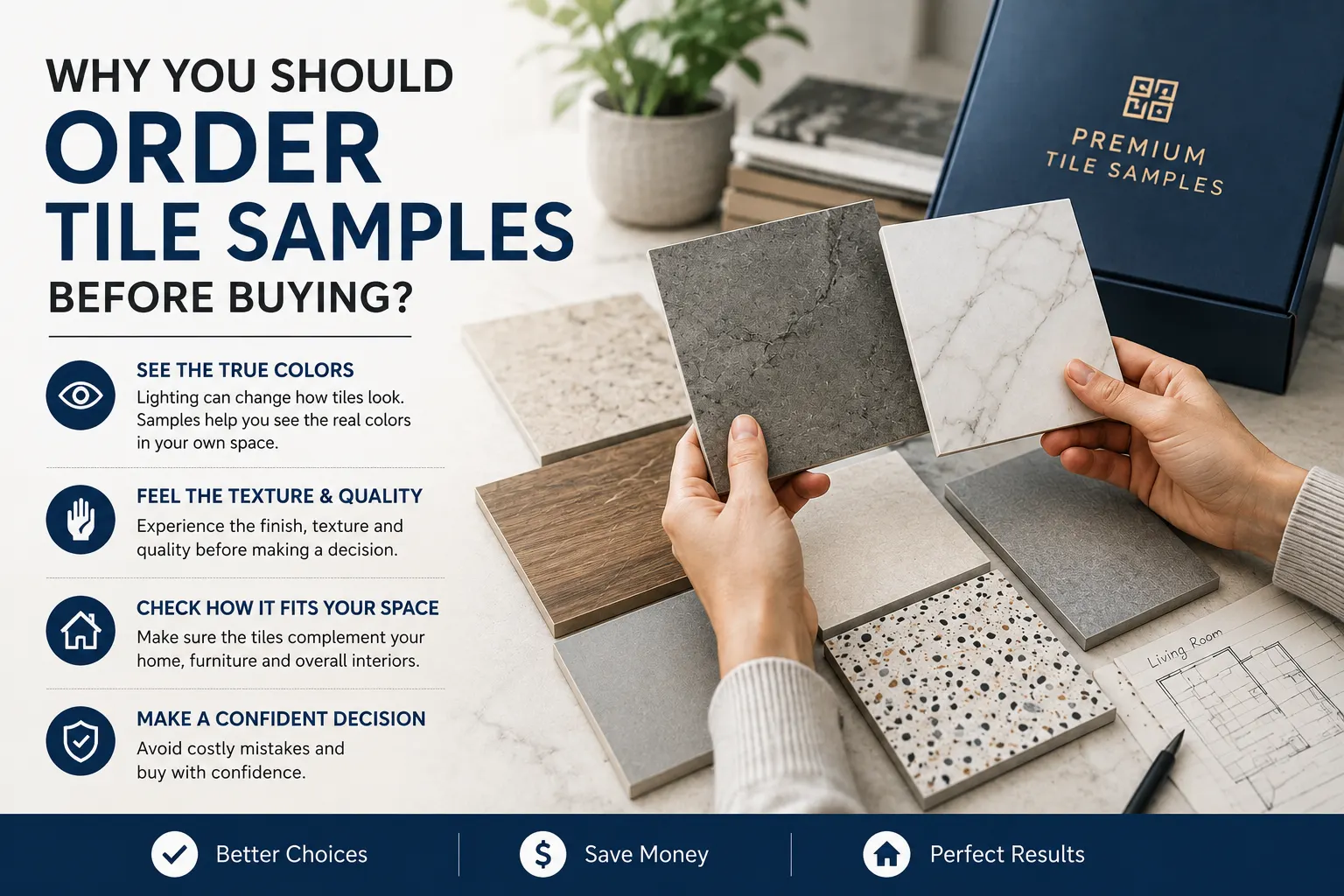
Why You Should Order Tile Samples Before Buying
Tile is a physical material and not a digital material. Let’s discuss in this topic why one should check the physical sample before ordering the tile.
Tile has so many aspects which are not possible to evaluate without checking the physical sample of the tile, like colour tone, surface finish, body quality, glaze quality, thickness of the tile, printing quality, and production batch variations. We will also discuss the facts and checkpoints that even regular buyers of porcelain tiles often ignore or do not understand how to check. We will discuss all those points here one by one.
Colour Tone
This is the main thing you can check with a physical sample rather than just taking a wild guess by seeing the image of the tile. To understand why the tile looks different in the image than the actual tile, let’s discuss the production process briefly.
The production of the tile starts with designing. The designer creates the design or scans the actual marble to copy that marble into the tile. Once the design is created and after making the desired changes in the design to make it more attractive and to look different and fresh from the other tiles available in the market, the designer cuts that full marble piece into different randoms. In simple language, we also call these randoms ‘the faces’ of the tile. A big-size marble design provides more randoms, and smaller-size carpets provide fewer randoms.
So it is also important to ask the supplier about the number of faces before making the final decision. Because if the tile is not provided with enough randoms, then the design looks very repetitive after the application on the wall or floor. But the number of faces required also depends upon the design you are selecting. The simple rule is, if the design has more characteristics and elements, it requires more faces, and if the design is subtle with fewer elements and figures, then it requires fewer faces.
Once the tile design is finalised digitally, it goes for printing. During the printing, the production team tries to match the colour tone of the tile with the tile image. The manufacturing team takes small-sized samples initially to check if the printing machine is understanding their design codes correctly or not.
In one piece of 60x120 cm, they mostly enter six different parameters of shades. Once that first sample is out, they check for the closest tone to match with the digital tile. Once that piece is finalised, they remove all other shades from the tiles and try to get it closer to the actual tile.
With repetitive attempts, they finally come 90% to 97% close to the actual tile image. In some cases where they cannot come very close to the digital tile, they make changes to the digital tile shade. So finally, your tile is matching 90% to 97% with the actual tile.
So as you can see, it is a very time-consuming and cost-consuming process, and not all manufacturers follow these strict standards and processes to provide the closest match between the digital and physical tiles. Therefore, it is very important to verify the colour tone of the tile sample before making the final purchase.
Sometimes the supplier provides you with images and videos of the tiles to make a judgement of the colour tone of the tile. This method is much better than checking the colour tone with the product catalogue. But here also, there are some chances that you may see a slightly different shade than the actual tile shade.
Many factors, like which mobile camera is used for the photography, which light is used, whether the tile is laid down on the floor or is in a standing position, and what the background behind the tiles is, can affect the shade of the tile while doing the photography.
So it is always advisable to check the physical sample of the tile if you are very particular about the colour shade you want to select for your tiles.
Surface Finish
This is another important characteristic of the tile which is not possible to measure without checking the physical sample of the tile. Now the days are gone when you had only two finishes available in the tile, glossy and matt.
Now there are more than 12 different finishes available in the market which are very popular amongst consumers and architects. Selecting the right finish of the tile is more important than selecting the right tone of the tile because the finish not only provides you with the look you desire, but it is a functional element as well.
You do not want your floor to be excessively slippery or too rough to clean properly.
Thickness of the Body
Different applications of the tile require different thicknesses and weights. It all depends on whether you are using this tile on the wall or floor, whether it is outdoor or indoor, what the size of the tile is, and whether there is any other material being used with the tile.
So there are multiple things where you need to check the thickness of the tile. Currently, the tiles are coming in various thicknesses from 5mm to 20mm. The most common thickness is 9mm, which is available in mostly all sizes and finishes.
When it comes to outdoor tiles, the recommended thickness is 12mm to 20mm. Our major market is in the UK and EU, and 20mm outdoor porcelain tiles are widely used there due to their strength.
The body of the tile is the heart of the tile. A weaker body will give you pain for a lifetime, and a stronger body will stay with you for a lifetime.
With the increasing competition in the market, suppliers are always looking to make their products economically viable in the market. The body of the tile is the first part where they start to cut down the production cost. You reduce the thickness of the body, and the cost of raw materials comes down straight away, and so does the cost of the tile.
And this is the most neglected part when it comes to quality evaluation of the tile. Buyers mostly check the colour tone and surface of the tile, but they do not check what the weight of the tile is. So it is very important to understand your thickness requirement and confirm with the supplier before making the decision.
Body Colour
There are mainly three types of tile bodies available in the market. The first and basic one is the regular porcelain body, the second one is the colour body, and the third one is the full body, which is the most expensive body among these three.
Let’s understand the difference between these three and how you can select the right body for your tile.
The regular porcelain body is the most commonly used body in the tile industry, and if you are selecting a tile for wall application and strength is not your main concern, then you can go for a regular porcelain body.
The colour body comes in a colour which matches the colour tone of the tile. It provides more clarity to the tile print and also provides extra strength compared to a regular porcelain tile.
The full body tiles are similar to natural stones. It is a homogeneous material throughout the tile. The top layer is just finished with matt polishing and nothing else.
So marble-like digital printing is not possible in real full body tiles. People use these tiles mainly for strength rather than for looks. But they are simple and equally beautiful as digitally printed tiles.
These are the main points one should keep in mind before making the purchase, and always prefer to check the physical sample of the tile.
At Top Notch Tiles, we provide free cut-size samples to any corner of the world. For our UK and EU-based clients, they can check the full-size samples in our displays or at our dealer network.
Please visit our website, www.topnotchtiles.com, to see the designs and request a free sample.
I hope this blog will help you in your purchase and in selecting the right tile.
