For more than two decades, the Indian porcelain tile industry has built its reputation on offering excellent quality at highly competitive prices. This combination has helped India become one of the world’s largest manufacturers and exporters of porcelain tiles, supplying customers across Europe, the UK, North America, the Middle East and many other international markets.
However, every industry faces defining moments that shape its future. The recent geopolitical conflict involving the USA and Iran has become one of those moments for the Indian ceramic industry.
A Challenge That Changed the Industry
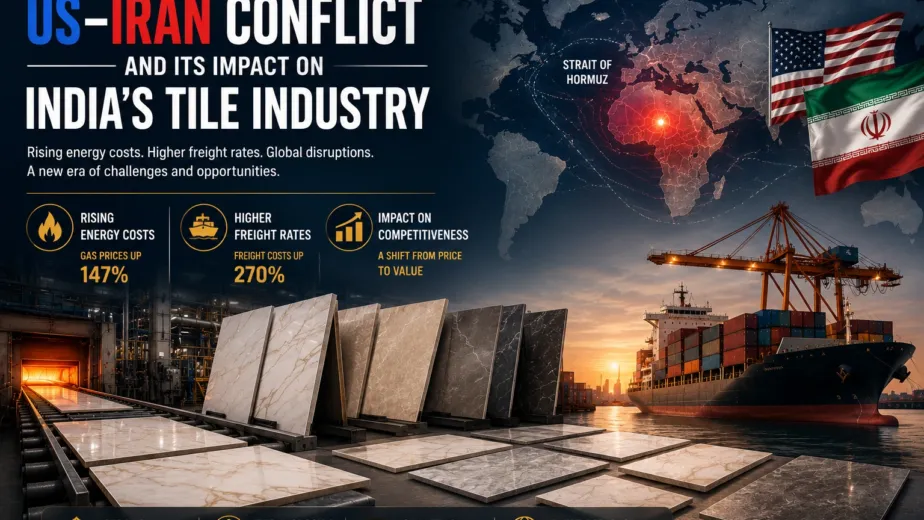
The disruption around the Strait of Hormuz significantly affected the supply of natural gas to India. Since natural gas is the primary fuel used in firing porcelain tiles at temperatures exceeding 1,200°C, any interruption immediately impacts production.
Morbi, Gujarat, recognised as one of the world’s largest ceramic manufacturing hubs, is home to more than 800 tile, sanitaryware and ceramic manufacturing units. Almost every factory depends heavily on a continuous supply of natural gas.
During April 2027, the industry experienced one of its most challenging periods in recent history. More than 700 manufacturing units temporarily suspended production due to shortages and rapidly increasing gas prices. Manufacturing gradually resumed in May 2027, but with significantly higher operating costs.
Before the crisis, natural gas prices were approximately ₹40 per kg. During the peak of the disruption, prices increased to around ₹96 per kg, and currently remain close to ₹89 per kg. Fuel prices also increased by approximately 7–8%, resulting in overall production costs rising by an estimated 30–40%.
The End of Competing Only on Price
For many years, India’s biggest competitive advantage was affordability. While maintaining good quality, Indian manufacturers could offer prices that were significantly lower than competitors in Spain, Italy and Turkey.
The recent increase in manufacturing costs has narrowed this price gap.
Spain and Turkey experienced relatively modest cost increases of around 5–10%, while Chinese manufacturers reported increases of approximately 20%. India, however, experienced one of the largest increases because of its dependence on imported natural gas.
Although this initially appeared to be a setback, it has encouraged manufacturers to rethink their long-term strategy.
A New Era for Indian Manufacturers
Across the industry, manufacturers are increasingly recognising that future success will no longer depend solely on offering the lowest prices.
Instead, the focus is shifting towards:
- Higher quality porcelain bodies
- Improved glaze technology
- Superior surface finishes
- Better body textures
- Premium design collections
- Greater consistency in production
At Top Notch Tiles Exporters Pvt. Ltd., we believe this transformation will make the Indian tile industry stronger than ever.
Rather than competing purely on price, Indian manufacturers are investing in technology, modern machinery and premium production techniques that will allow them to compete directly with Spanish and Italian manufacturers on quality.
Why We Remain Optimistic
India continues to enjoy significant long-term advantages.
Our labour costs remain highly competitive, raw material availability is excellent, manufacturing capacity continues to expand, and Indian factories are becoming increasingly automated.
Many manufacturers are upgrading from conventional digital production lines to modern full-body porcelain plants capable of producing premium collections for international markets.
As these investments continue, customers can expect to see Indian porcelain tiles offering significantly improved quality while remaining competitively priced against products from Spain, Italy and China.
India’s Leadership in Outdoor Porcelain
One area where India already enjoys a strong international reputation is outdoor porcelain paving.
The demand for 20 mm outdoor porcelain continues to grow rapidly across Europe and the UK, and India has become one of the leading manufacturing destinations for this product category.
Several well-known European brands now source outdoor porcelain products from Indian factories because of their excellent durability, consistent quality and competitive manufacturing capabilities.
At Top Notch Tiles, we are proud to be expanding our own outdoor porcelain collection, with new products scheduled for launch in November 2026.
Alongside our porcelain range, we will also introduce Arena Stone, our new premium brand specialising in natural sandstone paving. As one of the world’s largest exporters of natural stone products, India offers an exceptional foundation for building a world-class outdoor landscaping portfolio.
Looking Ahead
Every major challenge creates an opportunity for industries willing to evolve.
While the geopolitical conflict placed considerable pressure on manufacturers, it has also accelerated investment, innovation and quality improvements throughout the Indian ceramic sector.
We believe the next chapter of the Indian tile industry will not be defined by low prices alone, but by world-class quality, advanced manufacturing and greater value for customers worldwide.
At Top Notch Tiles Exporters Pvt. Ltd., we are proud to be part of this transformation. We remain committed to delivering premium porcelain tiles and natural stone products that combine innovative design, outstanding quality and long-term value for our customers across the UK, Europe and global markets.
The future of Indian ceramics is no longer about being the cheapest supplier. It is about becoming one of the world’s most trusted and respected producers of premium porcelain tiles.
The recent increase in manufacturing costs has narrowed this price gap.
Spain and Turkey experienced relatively modest cost increases of around 5–10%, while Chinese manufacturers reported increases of approximately 20%. India, however, experienced one of the largest increases because of its dependence on imported natural gas.
Although this initially appeared to be a setback, it has encouraged manufacturers to rethink their long-term strategy.