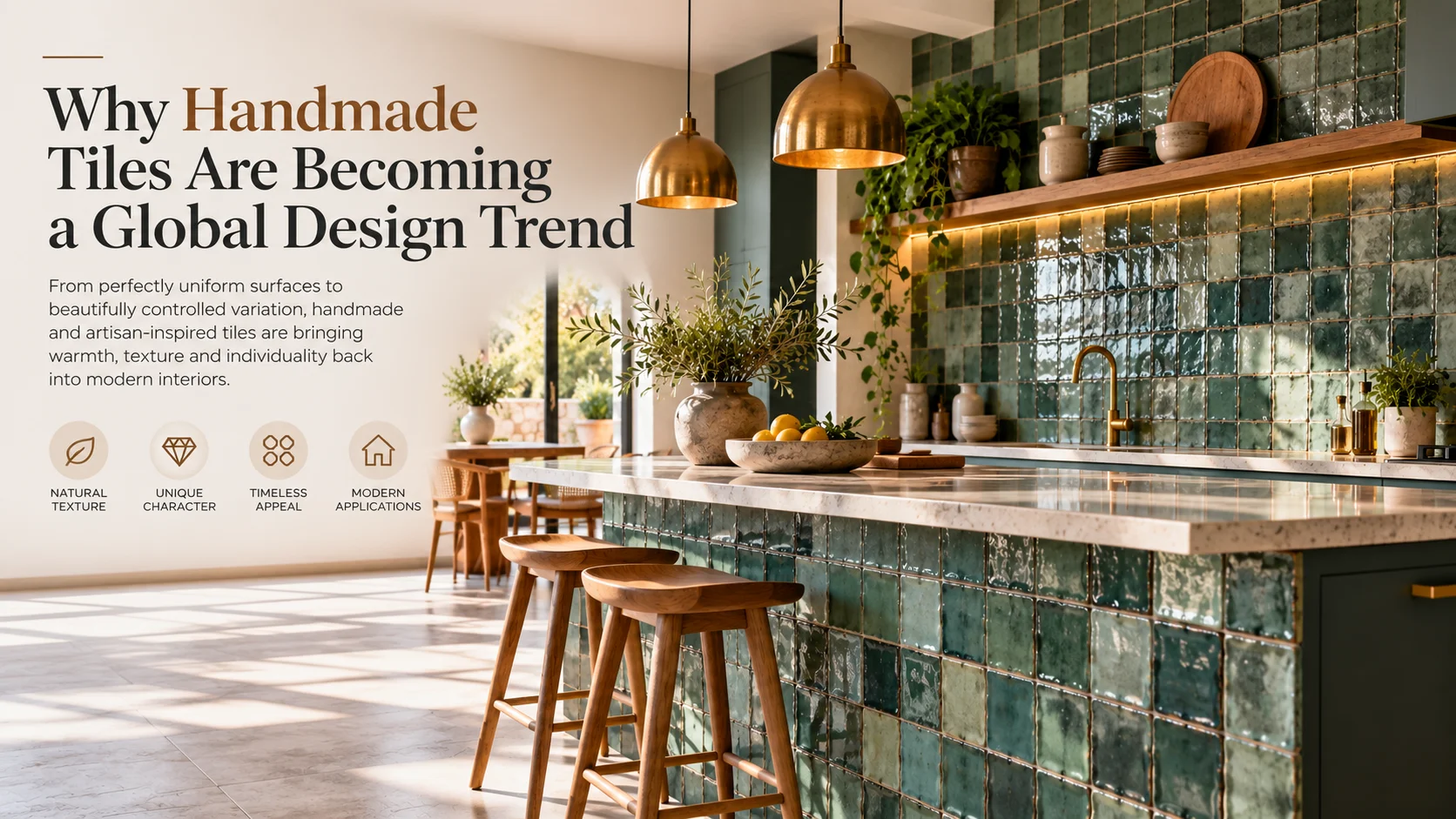
Why Handmade Tiles Are Becoming a Global Design Trend
For decades, the tile industry has been driven by precision, consistency and technological advancement. Modern manufacturing has made it possible to produce larger formats, sharper edges, consistent colours, realistic stone effects and highly detailed digital designs.
Yet the global tile market is beginning to move in another direction.
Alongside the demand for technical perfection, designers, architects and homeowners are showing increasing interest in surfaces that feel warmer, more authentic and more individual. This shift has brought renewed attention to handmade tiles, artisan-inspired tiles and handmade-look ceramic and porcelain products.
The attraction is not simply about making a tile look imperfect. Instead, subtle differences in colour, texture, glaze and edge definition can introduce character and create a more natural visual experience.
Recent interior and tile-design trends are also placing greater emphasis on craftsmanship, tactile surfaces and expressive materials. Coverings' 2026 trends, for example, highlight concepts such as "Haptic Experience," "Tailored Craft" and "Tile as Art", while its product showcases feature collections influenced by the natural character associated with handcrafted surfaces.
So, what is driving this renewed interest in handmade-inspired tiles?
What Exactly Are Handmade Tiles?
The phrase "handmade tiles" can refer to a wide range of products.
Some are genuinely produced, shaped, glazed or decorated by hand. Others are manufactured using advanced industrial processes but intentionally designed to recreate the appearance and character of traditional artisan tiles.
The category can include:
- Hand-glazed ceramic tiles
- Zellige-inspired tiles
- Hand-painted ceramic tiles
- Terracotta tiles
- Artisan ceramic collections
- Small-format decorative tiles
- Textured tiles with irregular edges
- Crackle-glaze tiles
- Handmade-effect porcelain and ceramic tiles
Unlike highly uniform factory-produced surfaces, variation is often an intentional design feature in these products.
A slight change in shade, texture or edge profile can prevent an installation from appearing repetitive. Instead, those differences can contribute to the overall visual identity of the space.
Why Is There Growing Interest in Imperfection?
Modern tile manufacturing has achieved an extraordinary level of consistency.
Manufacturers can produce tiles with almost identical:
- Dimensions
- Colours
- Finishes
- Patterns
- Surface effects
This consistency remains essential for many architectural and commercial applications. Advanced production technology has significantly improved product quality, reliability and performance.
However, interior design is not based entirely on technical precision.
A room also needs personality.
Increasingly, homeowners and designers want interiors that feel distinctive rather than mass-produced. They are looking for materials that introduce warmth, texture and visual interest.
This is one of the areas where handmade tiles can make a difference.
Minor differences between tiles can create additional depth across a wall or floor. Uneven glazing or textured surfaces can also respond differently to changing light conditions, producing subtle variations throughout the day.
The result can feel more organic than a perfectly repetitive printed surface.
The Growing Influence of Zellige-Style Tiles
One of the clearest examples of this movement is the growing popularity of Zellige-inspired tiles.
Traditional Moroccan Zellige tiles are recognised for their handcrafted appearance, irregular edges, tonal variation and reflective glazed surfaces. Their distinctive aesthetic has helped introduce more designers and consumers to the visual appeal of variation within ceramic surfaces.
However, the influence of this design language is no longer restricted to traditional Moroccan interiors.
Contemporary interpretations are appearing in:
- Modern kitchens
- Bathrooms
- Restaurants
- Boutique hotels
- Residential interiors
- Commercial spaces
This demonstrates an important point: handmade-inspired tiles do not have to create a rustic or traditional appearance.
They can also become part of highly contemporary interiors.
Texture Is Becoming Just as Important as Appearance
Another major factor behind the trend is the growing importance of tactile design.
For many years, tile innovation focused heavily on reproducing the appearance of natural materials such as marble, stone and timber.
Today, designers are increasingly interested in surfaces that provide a physical as well as visual experience.
The 2026 Coverings trend direction reflects this movement towards tactile and multi-sensory ceramic design, including embossed details, sculptural surfaces, ridges and finishes that interact with light.
This creates an interesting opportunity for artisan-inspired tiles.
A textured tile does not necessarily appear the same throughout the day. The way light reaches the surface can change how its relief, glaze and tonal variation are perceived.
Consequently, the tile becomes part of the overall interior composition rather than simply serving as a functional wall or floor covering.
Consumers Want More Individuality
There is also a broader shift taking place across interior design.
Many consumers and design professionals are moving away from spaces that look completely standardised. Instead, there is increasing demand for interiors that express personality and individuality.
The 1stDibs designer survey has also highlighted interest in more eclectic and expressive interiors, alongside growing use of vintage and antique-inspired elements by design professionals.
This does not necessarily indicate a return to traditional interiors.
Instead, designers are combining contemporary architecture and furniture with materials that communicate craftsmanship, history and individuality.
Handmade-style tiles fit naturally within this design philosophy.
For example, a relatively simple kitchen can gain visual character from a textured backsplash. A contemporary bathroom can feel warmer through the use of small-format glazed tiles. A restaurant can use distinctive ceramic surfaces to create a memorable environment for its customers.
Where Can Handmade Tiles Be Used?
Handmade and artisan-inspired tiles can be particularly effective in projects where atmosphere and visual identity are important.
Residential Applications
Potential residential applications include:
- Kitchen backsplashes
- Bathroom walls
- Shower areas
- Fireplace surrounds
- Feature walls
- Utility rooms
- Decorative floors
Because these products often have strong visual character, they can be used to create a focal point without requiring extensive decoration elsewhere in the room.
Hospitality Applications
Hotels, restaurants, cafés and bars are another important area.
Hospitality designers often need interiors that are visually distinctive and memorable. Tile can contribute significantly to this identity.
A carefully selected handmade-inspired collection can make a commercial interior feel more individual and less like a standardised space.
Luxury Residential Projects
High-end residential projects can also benefit from artisan-inspired surfaces.
Architects and interior designers can use colour, texture and subtle variation to introduce character into otherwise minimalist spaces.
This approach can be particularly effective when other materials in the room are intentionally restrained.
Handmade Does Not Mean Traditional
One misconception about handmade tiles is that they are only suitable for old-fashioned, rustic or heritage-style interiors.
Modern design is challenging that assumption.
Consider a minimalist kitchen featuring simple cabinetry, natural timber and a wall finished with slightly irregular glazed tiles.
The contrast between clean architectural lines and handcrafted-looking surfaces can create a sophisticated result.
The same approach can work in:
- Contemporary bathrooms
- Boutique hotels
- Modern restaurants
- Luxury apartments
- Designer retail spaces
The handmade element can introduce warmth and visual softness into an otherwise precise and minimalist environment.
Handmade Tiles and Handmade-Look Tiles Are Not the Same
There is an important difference between genuinely handmade products and tiles that are manufactured to replicate a handmade appearance.
Authentic handmade tiles can display significant variations and may require specialised production techniques as well as more careful installation.
By comparison, handmade-look tiles are manufactured using modern technology while incorporating design characteristics associated with traditional artisan products.
These characteristics may include:
- Irregular-looking edges
- Tonal variation
- Surface movement
- Glaze variation
- Natural-looking textures
- Small-format designs
This second category could become particularly relevant to international markets.
Designers may want the warmth and individuality of handmade surfaces, while architects, contractors and distributors still require dependable dimensions, technical performance, production capacity and reliable supply.
This creates an interesting space where modern manufacturing technology and traditional design inspiration can work together.
The Manufacturing Challenge
Producing a convincing handmade appearance is more complicated than simply making a tile irregular.
If variation is excessive, installation can become difficult and the finished surface may lose visual balance.
If variation is too limited, the product may appear artificial.
Manufacturers therefore need to find an appropriate middle ground.
Important factors can include:
- Colour variation
- Glaze behaviour
- Surface texture
- Dimensional accuracy
- Flatness
- Shade consistency
- Edge characteristics
The objective is not uncontrolled imperfection.
The real goal is controlled variation.
Achieving that balance requires strong product-development capabilities, knowledge of ceramic and glaze technology, manufacturing expertise and a clear understanding of the expectations of architects, designers and international buyers.
A Potential Opportunity for Indian Tile Manufacturers
This changing design preference could create an interesting opportunity for India's ceramic manufacturing sector.
India already has a large and established tile manufacturing industry, with Morbi serving as a major centre of ceramic production.
Indian manufacturers possess considerable capabilities across ceramic manufacturing, glazing, digital decoration, small-format production and export-oriented manufacturing.
The opportunity may now be to combine these established capabilities with more distinctive and design-focused collections.
Rather than competing primarily through price and production volume, manufacturers can develop products aimed at customers seeking differentiation.
Potential product categories could include:
- Architect-focused collections
- Boutique hotel tile ranges
- Decorative wall tiles
- Small-format ceramic tiles
- Textured surfaces
- Artisan-inspired collections
- Designer-led products
For Indian exporters, this could help create access to a different segment of international buyers.
These customers are not simply purchasing square metres of tile.
They are purchasing design, atmosphere, character and individuality.
Combining Craftsmanship With Technology
The increasing popularity of handmade-inspired tiles does not mean that large-format porcelain, marble-effect surfaces or technologically advanced tile products are becoming irrelevant.
There is space for both approaches.
A large-format porcelain slab may be the ideal solution for one architectural project, while a small-format handmade-look ceramic tile may be better suited to another.
The more interesting development is the possibility of combining the advantages of both worlds.
Modern manufacturing can deliver:
- Consistency
- Durability
- Scalability
- Technical performance
- Reliable supply
Traditional craftsmanship and artisan-inspired design can contribute:
- Character
- Warmth
- Texture
- Variation
- Individuality
The strongest products may therefore be those that successfully bring these two approaches together.
What Does This Mean for the Future of Tile Design?
The renewed interest in handmade tiles is part of a wider change in interior design.
Designers and consumers are increasingly looking for surfaces that provide more than basic functionality. They want texture, colour, visual depth and a sense of individuality.
Handmade and handmade-look tiles respond naturally to this demand.
For manufacturers, this should not be viewed simply as another short-term style trend.
It represents an opportunity to rethink product development and explore collections that offer something beyond conventional technical specifications.
For decades, the tile industry has invested heavily in achieving greater precision and uniformity.
The next opportunity may be to explore how controlled variation can create something equally valuable: beautiful imperfection.
For Indian manufacturers and exporters in particular, combining advanced production capabilities with artisan-inspired design could become an exciting direction for the next generation of global tile collections.