
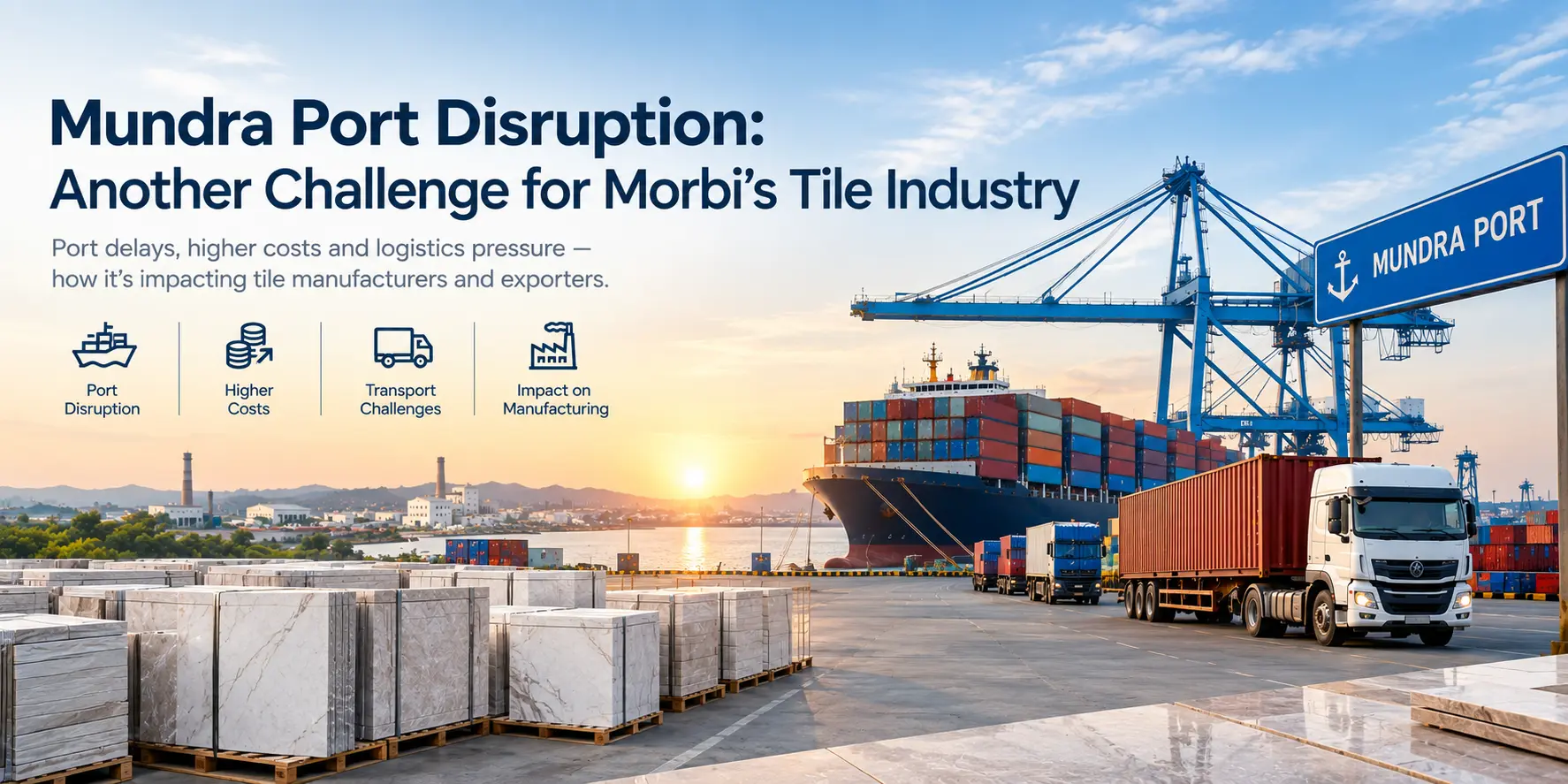
Mundra Port Disruption: Another Challenge for Morbi’s Tile Industry
Morbi’s ceramic and porcelain tile industry has already experienced a challenging year in 2026. Rising energy expenses, elevated shipping costs and weaker buying activity from some international markets have created pressure on manufacturers and exporters.The industry is now facing another logistical challenge: disruption to container transportation around Mundra Port.For a major export hub such as Morbi, reliable container movement is essential. A prolonged disruption does not only affect shipments — it can eventually create problems inside the factories themselves.
What Is Happening Around Mundra Port?
It is important to understand that Mundra Port has not simply shut down.
Port and vessel-related operations continue.The major difficulty has been connected with road transportation and the movement and handling of empty containers.
The situation developed following changes introduced by Adani Ports and Special Economic Zone Ltd. regarding the management of empty import and export containers at Mundra.Under the proposed system, a greater proportion of empty containers would be handled through designated facilities within the Mundra SEZ rather than through the existing network of private empty-container yards outside the port.
The objective is to make container handling more streamlined while improving security and reducing unnecessary movements. However, private container-yard operators have raised concerns about the impact of these changes on their existing operations.
The disagreement subsequently affected container transport operators, with a significant number of transporters reportedly stopping container movement around Mundra.
The result has been disruption for businesses that depend on the regular movement of containers — including exporters in Morbi.
Why Does Mundra Matter So Much to Morbi?
Morbi is one of the world's major ceramic manufacturing centres, with a large portion of its production destined for international markets.
Tile factories operate differently from many other manufacturing businesses.Ceramic and porcelain production lines are designed to run continuously. Kilns operate at extremely high temperatures and are generally kept running around the clock, except during planned maintenance or significant operational issues.
As production continues, finished tiles are packed and moved into storage.Normally, the process works as a cycle:
Production → Packing → Warehouse → Container Loading → Port → International Customer
When container availability or transportation is interrupted, the final stages of this cycle slow down.The factory can continue producing tiles, but finished goods begin accumulating in its warehouses.If the situation continues for long enough, storage capacity becomes a serious issue.
Eventually, manufacturers may have to reduce production or temporarily stop certain production lines simply because there is insufficient space to store additional finished goods.
This is why a transportation problem at Mundra can eventually have a direct impact on manufacturing activity in Morbi.
Existing Stock Levels Make the Situation More Difficult
The current disruption comes at a particularly difficult time.During recent months, international shipping costs from India to markets such as the UK, Europe and the United States have remained under pressure.
For the tile industry, freight costs are particularly important because porcelain and ceramic tiles are heavy and occupy considerable container capacity.When ocean freight increases significantly, the landed cost of a shipment rises. This can affect the final selling price as well as the exporter's margin.
As a result, some international buyers have delayed shipments or reduced purchasing frequency while waiting for freight conditions to improve.This has contributed to higher finished-goods inventories at some manufacturing units.
With container transportation now facing additional disruption, manufacturers have fewer opportunities to clear that existing stock.In other words, the industry is dealing with a logistics problem at a time when warehouse pressure already exists.
Rising Energy Costs Are Another Challenge
Logistics is not the only issue affecting Morbi manufacturers.Energy costs have also been an important concern for the ceramic industry.
Producing porcelain and ceramic tiles requires substantial amounts of energy because the products need to be fired at very high temperatures.
Any significant increase in gas, fuel or other energy-related expenses directly increases manufacturing costs.
The broader instability in the Middle East has also contributed to uncertainty across energy and transportation markets.This means manufacturers are currently dealing with several pressures simultaneously:
- Higher manufacturing costs
- Expensive international freight
- Slower export movement
- Increased finished-stock levels
- Container transportation disruption
- Uncertainty in international demand
Each challenge creates additional pressure on manufacturers. When several occur at the same time, maintaining competitive pricing and production becomes considerably more difficult.
Freight Rates Could Provide Some Relief
There is, however, a positive development for exporters.Ocean freight rates on some important international routes have recently shown signs of easing.
If this trend continues, it could encourage overseas buyers to resume more regular purchasing and shipping activity.Many buyers have been cautious because of elevated freight costs.
A sustained reduction in shipping expenses could therefore help improve export volumes.
For Morbi manufacturers, the combination of lower freight rates and improved container availability could provide much-needed relief.However, this recovery depends partly on the container transportation situation around Mundra being resolved.
Why a Quick Resolution Is ImportantThe interests of everyone involved are closely connected.
Ports need containers to move efficiently.Transport companies need their vehicles operating.Shipping companies need containers circulating through the supply chain.Manufacturers need to dispatch finished products.
Importers and distributors overseas need their orders to arrive according to schedule.A prolonged disruption affects every stage of this process.For an exporter, even a short delay can create complications.
A container may already be packed and a vessel booking may already be confirmed, but if the truck cannot reach the port on time, the shipment could miss its planned sailing.
That can result in additional costs, delivery delays and customer dissatisfaction.For international customers, the internal reasons behind a logistics delay are often less important than the final outcome: whether their goods arrive when expected.
Exporters Are Facing the Consequences
There are different perspectives involved in the Mundra dispute.Port operators have their reasons for changing container-management systems.
Private container yards have invested in infrastructure and operations over many years. Transporters also have concerns regarding how the new arrangements may affect their businesses.
However, exporters and manufacturers are caught in the middle.They may have no involvement in the dispute itself, yet their businesses depend on the system functioning smoothly.
A manufacturer can have:
- Finished stock ready for dispatch
- A confirmed customer order
- A shipping booking
- A packed container
But if the transportation network cannot move that container efficiently, the entire shipment can be delayed. For companies supplying overseas markets, reliability is almost as important as price and product quality.
What This Means for Morbi's Tile Industry
The current situation highlights an important reality about modern manufacturing.Being competitive is not only about producing a quality product at the right price.
The entire supply chain has to work.For Morbi's tile manufacturers, that supply chain includes:
Raw materials → Energy → Manufacturing → Packaging → Road Transport → Containers → Port → Shipping → International Distribution
A disruption at any one of these stages can affect the complete operation.Morbi has developed into one of the world's largest ceramic manufacturing centres because of its manufacturing capabilities, skilled workforce, extensive supplier network and strong export connections.However, continued international growth also requires dependable logistics infrastructure.
The Importance of Reliable Export
InfrastructureAs India's tile exports continue to serve customers around the world, dependable ports and transportation networks will become increasingly important.Manufacturers can control many aspects of their business — product quality, production efficiency, packaging and customer service.
They have far less control over port congestion, container availability, road transportation or international shipping costs.This makes a stable logistics network essential for maintaining India's position in global tile markets.
At Top Notch Tiles, our involvement in manufacturing and international exports gives us a direct understanding of the challenges faced by the Morbi tile industry.
The current situation is another reminder that manufacturing and logistics are closely connected.
Looking Ahead
The Morbi tile industry has already demonstrated its ability to adapt to changing market conditions.Manufacturers have dealt with fluctuating energy costs, changing freight rates, international demand cycles and increasingly competitive global markets.
The current Mundra disruption is another challenge, but hopefully a temporary one.A quick resolution between the relevant stakeholders, combined with improving freight conditions, could allow container movement to return to normal and help manufacturers gradually reduce accumulated inventory.
If logistics conditions improve during the coming weeks, Morbi exporters may be in a stronger position to increase shipments and respond to renewed international demand.
For now, manufacturers and exporters will be closely watching developments at Mundra while continuing to manage production, inventory and customer commitments as efficiently as possible.
Morbi's tile industry has built its global reputation on manufacturing strength. The next step is ensuring that the logistics network supporting that manufacturing base remains equally reliable.
